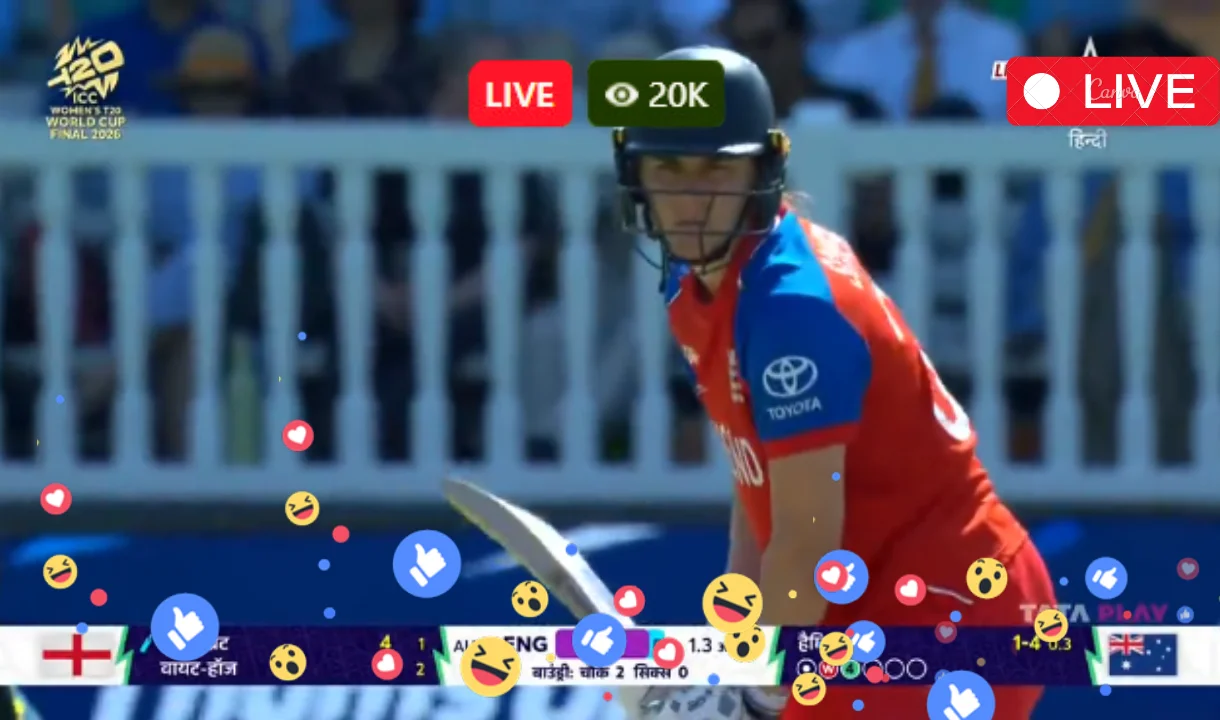
The Women’s T20 World Cup 2026 has arrived at its biggest moment. Hosts England face six-time champions Australia in the final on Sunday, July 5, 2026, at Lord’s Cricket Ground, London — the same ground where England lifted their only title, back in 2009.
Official Match Details
- Match: Final — England Women vs Australia Women
- Tournament: ICC Women’s T20 World Cup 2026
- Date: Sunday, July 5, 2026
- Time: 3:30 PM local (BST) / 8:00 PM IST / 10:30 AM ET / 4:30 PM SAST / 12:30 AM AEDT (July 6)
- Venue: Lord’s Cricket Ground, London
Where to Watch
- Coverage is being shown globally through the ICC’s broadcast partners, with JioHotstar carrying a vertical live feed with multi-camera coverage in India.
- Live scores and ball-by-ball updates are available on ESPNcricinfo and the ICC’s official channels.
Live Streaming Info:The final of the Women’s T20 World Cup 2026 will be live on Star Sports.
Live Score Info:
England Women vs Australia Women Final of World Cup 2026: All matches on ESPN and Cricbuzz have live scores.
The Road to the Final
Both finalists arrive unbeaten, which makes this a genuinely even contest on paper.
England have had a perfect tournament, winning every single match across the group stage and knockouts without dropping a game — six wins from six. Their semi-final win over South Africa came by 40 runs, built on a middle-order recovery after early wickets fell.
Australia booked their spot with an eight-wicket win over the West Indies in the first semi-final. Chasing a modest target, Beth Mooney anchored the chase with a composed unbeaten innings to guide her side home comfortably, extending Australia’s unbeaten run through the tournament.
Squads
England Women: Nat Sciver-Brunt (c), Amy Jones (wk), Danni Wyatt-Hodge, Sophia Dunkley, Alice Capsey, Heather Knight, Freya Kemp, Danielle Gibson, Charlie Dean, Sophie Ecclestone, Linsey Smith, Lauren Bell, Issy Wong, Lauren Filer, Tilly Corteen-Coleman
Australia Women: Sophie Molineux (c), Ashleigh Gardner (vc), Tahlia McGrath (vc), Beth Mooney (wk), Georgia Voll, Phoebe Litchfield, Ellyse Perry, Grace Harris, Georgia Wareham, Annabel Sutherland, Nicola Carey, Kim Garth, Lucy Hamilton, Megan Schutt, Alana King
Easy-Language Breakdown: Why This Match Is So Close
Think of this final as two very well-built teams with almost no weak link — the kind of match that usually gets decided by two or three key moments rather than one team simply outclassing the other. Here’s the simplest way to understand the contest:
England’s game plan
England want to bat first if they win the toss, or bat with intent if chasing, and let their top three set the tone. The whole strategy revolves around one idea: get a fast start, then let experience finish the job.
- Danni Wyatt-Hodge is the key. She’s been the leading run-scorer of the entire tournament, and if she gets 15–20 balls to settle, England’s total tends to look after itself.
- Heather Knight and captain Nat Sciver-Brunt are the safety net. In the semi-final, when England lost early wickets, these two rebuilt the innings together and finished it with acceleration at the end — that’s likely to be the template again if the top order stumbles.
- With the ball, Sophie Ecclestone is the control bowler who dries up the middle overs, while Charlie Dean and Lauren Bell have been the most consistent wicket-takers of the tournament for England.
Australia’s game plan
Australia’s approach is built on discipline and depth — they don’t rely on one match-winner, they rely on having six or seven players who can each win a game on their own day.
- Beth Mooney is historically outstanding against England specifically — her past record against England is by far the best of any player from either side in recent meetings. If she gets in, Australia’s chase or defence becomes very hard to stop.
- Ellyse Perry adds calm, experienced middle-order support, though her fitness after retiring hurt in the semi-final with a minor injury is one thing to watch.
- Georgia Wareham has quietly been the form player of the tournament — fastest scoring rate with the bat and one of the tightest bowling economies. She also has a strong record of getting Sciver-Brunt out cheaply, which could be a key early battle.
- Captain Sophie Molineux leads from the front with the ball, already among the tournament’s top wicket-takers.
The key head-to-head battle to watch
Danni Wyatt-Hodge (England’s explosive opener) vs Kim Garth (Australia’s new-ball bowler) will likely decide how England’s innings starts. If Garth gets early success, England’s chase-recovery model gets tested immediately. On the other side, England’s spinners will look to target Beth Mooney early, since letting her bat deep into an innings has historically been very costly for opponents.
Head-to-Head Record
- This is the fourth Women’s T20 World Cup final between these two sides — Australia have won all three previous meetings (2012, 2014, 2018).
- Australia have won 6 of the last 8 T20Is against England overall, including their last three in a row.
- Overall, Australia are six-time champions; England have won the title once, in the very first edition in 2009 — at this same ground, Lord’s.
Conditions
Lord’s in July typically offers a good, true batting surface with some assistance for pacers early on and turn for spinners as the pitch wears later in the innings. Given both attacks have strong spin options, the middle overs are likely to be a tactical battle rather than an all-out slog.
Prediction
This is about as even as a final can get — two unbeaten teams, both with match-winners in form, and very little separating them on paper. Australia’s edge is their sheer final-day experience and their historical dominance over England in this exact fixture. England’s edge is home support, momentum from a gritty semi-final comeback, and the emotional pull of trying to repeat their 2009 heroics on the same ground.
If England’s top three fire together, they have enough depth to post a total Australia will have to work hard to chase. If early wickets fall again, it will likely come down to whether Knight and Sciver-Brunt can repeat their semi-final rescue act — against a more clinical, more experienced Australian attack this time.