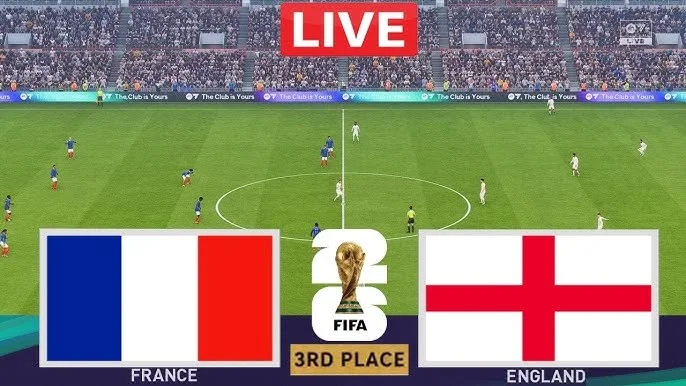
France vs England meet in the 2026 FIFA World Cup third-place playoff in Miami, a high‑profile bronze final between two of Europe’s heavyweight national teams. With both sides still stacked with elite talent and plenty of narrative around Deschamps’ farewell and England’s response to semi-final heartbreak, this has all the ingredients of a compelling, open contest.
Hard Rock Stadium has been one of the showpiece venues of this North American World Cup, and a packed crowd is expected despite the “consolation” nature of the fixture.
Miami in mid‑July typically brings hot, humid conditions, with evening temperatures still hovering in the high 20s Celsius and humidity levels above 70%, plus a chance of thunderstorms and slick surfaces if rain hits before or during the game. Such conditions tend to favour sides who can manage tempo and rotate heavily, and France’s deeper bench of dynamic attackers could be an advantage as legs tire in the second half. England’s more methodical approach under Thomas Tuchel may be tested by the need to press and recover in heavy air, and hydration breaks and substitutions will be crucial in managing fatigue and cramp.
This is a bronze final neither side wanted, yet there is still plenty on the line. France arrive after a 2–0 semi‑final defeat to Spain, while England fell 2–1 to Argentina in a bitterly debated loss. A third‑place medal offers tangible silverware, ranking points, and a positive closing image heading into the next cycle, particularly for a France side saying goodbye to Didier Deschamps in his 187th and final match in charge.
For England, this is a third World Cup third‑place playoff – they lost to Italy in 1990 and Belgium in 2018 – and avoiding a third defeat in such games is one motivation. The pressure narrative is different: Deschamps is looking to go out in style after winning the World Cup as both player and coach, while Tuchel is under scrutiny after England led Argentina but retreated, allowing Lionel Messi to dictate and ultimately turn the semi‑final around. Both camps know that a lacklustre performance here will colour public perception of otherwise respectable campaigns.
France vs England match details
-
Match: France vs England
-
Competition: FIFA World Cup 2026 – Third-place playoff (Bronze final)
-
Date: Saturday, 18 July 2026 (local US time)
-
Kick-off time: 21:00 BST / 01:30 IST (19 July)
-
Venue: Hard Rock Stadium, Miami Gardens, USA
FIFA World Cup 2026 Live Streaming Info
The FIFA World Cup 2026 is being co-hosted by the United States, Mexico, and Canada, running from June 11 to July 19, 2026, across 48 teams and 104 matches.
Live Streaming Info:
France vs England 3rd Place FIFA World Cup will be live on Bein Sports 5
Live Score Info:
France vs England 3rd Place FIFA World Cup 2026: All matches on FlashScore have live scores.
Head-to-head record
France vs England is one of European football’s classic rivalries, and recent history leans toward Les Bleus.
-
Total meetings: 34 matches in all competitions.
-
France wins: France have edged recent competitive encounters and major‑tournament meetings, including the 2–1 win in the 2022 World Cup quarter-final in Qatar.
-
England wins: England’s last win in this dataset came in a 2–0 friendly at Wembley in November 2015.
-
Draws: There have been multiple draws, including 1–1 in the UEFA Euro 2012 group stage and a 2000 friendly.
-
Last five meetings: France 2–1 England (World Cup 2022), France 3–2 England (friendly 2017), France 2–1 England (friendly 2010), England 2–0 France (friendly 2015), France 1–1 England (Euro 2012).
Over the last nine matches, England have just one win against France (D2 L6), underlining the psychological edge Les Bleus carry into this contest.
Recent meetings snapshot
Team A: France analysis
France come in off a run of four straight wins before their semi‑final loss to Spain, beating Norway 4–1, Sweden 3–0, Paraguay 1–0 and Morocco 2–0 in this World Cup. That sequence highlights their blend of attacking power and defensive solidity, with multiple clean sheets and heavy scoring against sides that also challenged England.
Their primary strengths lie in transition pace, individual brilliance in the front line, and a midfield that can both destroy and distribute. Mbappé has eight goals at this World Cup, Ousmane Dembélé five, and wide options like Bradley Barcola and Michael Olise stretch the pitch relentlessly. N’Golo Kanté and Aurélien Tchouaméni offer ball‑winning and balance in midfield, allowing France to spring quick counters or sustain pressure.
Potential weaknesses include occasional over‑reliance on Mbappé’s productivity and a tendency to leave space for counters when full‑backs push high, as exposed by Spain’s control and their success in pinning France back. If France struggle to control central zones, they can be limited to lower‑quality chances, as seen in their 0.31 expected goals return against Spain – their worst on record at a World Cup.
Key players:
-
Kylian Mbappé – top scorer of the tournament so far, lethal in transition and one‑v‑one situations.
-
Ousmane Dembélé – unpredictable wide dribbler who can unbalance England’s back line.
-
N’Golo Kanté – provides coverage for full‑backs and disrupts England’s passing chains.
-
Aurélien Tchouaméni – key in ball progression and screening in front of the centre-backs.
Expected tactical approach:
France are set to line up in a 4‑3‑3, using width and high tempo. Predicted XI: Maignan; Koundé, Upamecano, Saliba, T. Hernández; Tchouaméni, Kanté, Rabiot; Dembélé, Mbappé, Barcola. Expect Mbappé to operate off the left, attacking the inside‑right channel between Reece James and John Stones, with Dembélé running at Tino Livramento on the opposite flank. France will look to drag England’s back line across with wide overloads before feeding Mbappé centrally, a pattern that has worked throughout the tournament.
Team B: England analysis
England’s recent form is more uneven: a 2–1 loss to Argentina, 1–1 draw with Norway, plus tight wins over Mexico (3–2), DR Congo (2–1) and Panama (2–0). They have shown resilience and late‑game character but not the capacity to dominate matches for sustained spells.
England’s main strengths include their attacking spine of Kane and Bellingham, who have six goals each at this World Cup, and a wide cast of forwards such as Bukayo Saka and Marcus Rashford who can hurt teams cutting inside. Declan Rice anchors midfield intelligently, breaking up play and recycling possession. Under Tuchel, England can switch between a compact mid‑block and more aggressive pressing phases.
Their weaknesses centre on defensive lapses and game management. The semi‑final against Argentina highlighted issues: once ahead, England dropped deep, ceded possession (down to 12% during their period with the lead), and allowed Messi to control the game, ultimately suffering for that passivity. There are also lingering questions over defensive transitions, especially when full‑backs push high and Rice is left covering large spaces alone.
Key players:
-
Harry Kane – clinical finisher, key reference point, chasing personal World Cup scoring history (14 goals).
-
Jude Bellingham – drives the press, carries the ball, and arrives late in the box to score.
-
Bukayo Saka – offers width and creativity cutting in from the right.
-
Declan Rice – England’s defensive anchor tasked with dealing with Mbappé’s channels.
Expected tactical approach:
England are expected to use a 4‑2‑3‑1. Predicted XI: Pickford; Reece James, Stones, Guehi, Livramento; Rice, Mainoo; Saka, Bellingham, Rashford; Kane. Tuchel will likely ask Rice and Kobbie Mainoo to compress central spaces and protect against France’s counters, while the front four look to attack the half‑spaces and deliver early balls into Kane. The big tactical question is whether England hold a higher line and maintain aggression if they score first, or revert to the conservative pattern that cost them against Argentina.
Probable XIs (clean format)
-
France probable XI: Maignan, Koundé, Upamecano, Saliba, T. Hernández, Tchouaméni, Kanté, Rabiot, Dembélé, Mbappé, Barcola.
-
England probable XI: Pickford, Reece James, Stones, Guehi, Livramento, Rice, Mainoo, Bellingham, Saka, Rashford, Kane.
Key players to watch
Mbappé is the standout protagonist; with eight goals already, he is chasing the golden boot and has consistently scored in every stage of this World Cup. His pace and movement between full‑back and centre‑back will force England to adjust their defensive structure, and any one‑v‑one with Livramento or Stones could be decisive.
For England, Kane’s finishing and link play remain crucial, but Bellingham might be the real barometer of their performance. When he is allowed to press high and break lines with the ball, England look energetic and dangerous; when he is pinned back, they lose vertical threat and cede initiative. Saka and Rashford, attacking the half‑spaces off his service, can exploit gaps if France push their full‑backs high.
The midfield duel of Rice versus France’s rotations – particularly his responsibility to track Mbappé when he drifts infield – is another key storyline. If Rice cannot restrict Mbappé’s space, France’s attacking combinations may be too fluid for England to contain.
Trends: form, records and stats
-
Recent results: France arrive with four wins and one loss in their last five World Cup matches, while England have three wins, one draw and one loss.
-
Home/away dynamic: On neutral ground, France’s tournament experience and comfort in big‑stage knockout games is a subtle advantage; England’s third bronze final appearance brings baggage after two previous defeats.
-
Goal-scoring trends: France have averaged over two goals per game across their winning run and have scored in every match at this World Cup. England have conceded in four of their five fixtures, highlighting defensive fragility despite good attacking output.
-
Defensive records: France kept multiple clean sheets (Morocco, Paraguay, Sweden), while England’s only clean sheet in this recent stretch came against Panama.
-
Set-piece effectiveness: Both sides possess serious set‑piece weapons – Kane and Bellingham for England, Mbappé and France’s tall centre-backs – but England’s reliance on dead‑ball situations has grown as open‑play control has fluctuated.
-
Possession and attacking stats: England’s semi‑final collapse was underpinned by extreme possession imbalance, dropping to just 12% during the period they led Argentina. France, by contrast, struggled to generate xG against Spain but generally have produced strong attacking metrics against lesser defences.
These patterns point to a game that could open up significantly, especially if either side scores early and the other is forced to chase.
Tactical battles and match prediction
The defining tactical battle is likely to be France’s wide overloads versus England’s defensive structure. If Dembélé and Barcola can stretch the back line, Mbappé will find channels to attack; Rice’s ability to shield and James/Livramento’s one‑v‑one defending become critical. At the other end, Kane’s dropping movements to connect with Bellingham and Saka could trouble France’s midfield if Tchouaméni and Kanté are dragged out of position.
However, France’s superior goal return, their psychological edge from Qatar, and greater consistency across this tournament make them rightful favourites, with models and bookmakers alike leaning towards a French win. Total Football Analysis and Opta’s supercomputer both see France winning inside 90 minutes more often than not in their projections.
Expect both teams to score in an open, attacking game, but France’s sharper cutting edge and fresher mentality – plus the motivation to send Deschamps off with a win and Mbappé’s golden‑boot chase – should give Les Bleus the edge over 90 minutes.