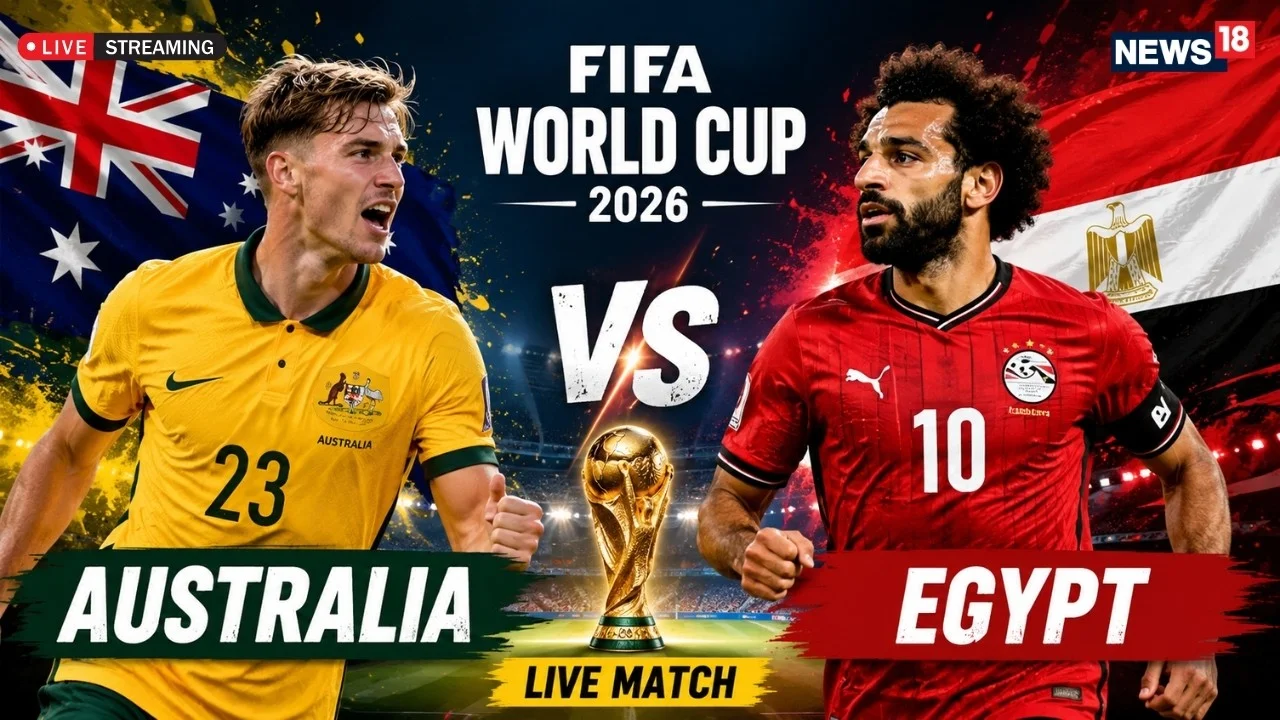
Australia vs Egypt is a World Cup Round of 32 knockout tie at AT&T Stadium in Arlington, and it looks set up as a tight, tactical game rather than an open shootout. Australia come in with the cleaner defensive profile, while Egypt arrive with more attacking volume and the bigger individual star power, so the winner may well come down to who handles the pressure moments better.
Detailed live weather readings were not available in the sources I checked, so I can only give a venue-based match read rather than a verified forecast. AT&T Stadium is a closed, climate-controlled venue, which usually reduces the effect of heat, wind, and rain on passing, pressing, and set pieces. That means the game should be decided more by structure, transitions, and set-piece execution than by weather disruption.
This is a knockout match with a place in the Round of 16 on the line, so there is no room for recovery if a team starts slowly. Australia’s tournament profile has been built on being hard to break down, while Egypt’s has been driven more by possession and attacking output, which creates a classic control-versus-carrying-threat matchup. The psychological angle matters too: Egypt’s only previous meeting with Australia ended 3-0 to Egypt in a 2010 friendly, but that is mostly a historical footnote rather than a reliable guide.
Australia have been stubborn, with two clean sheets in three tournament games and five straight matches going under 2.5 goals, which tells you they are comfortable in low-margin football. Their tournament averages sit around 40.7 percent possession, 26 shots, 11 on target, two goals scored and two conceded, which underlines a disciplined but relatively conservative approach. Egypt are unbeaten in three, have scored five goals, and have generated more possession and more shots, but they still have not kept a clean sheet in the tournament.
Match details
-
Match: Australia vs Egypt.
-
Competition: FIFA World Cup 2026, Round of 32.
-
Date: Friday, 3 July 2026.
-
Kick-off Time: 19:00 local time in Arlington / Dallas, which is 19:00 PKT? No, for Pakistan readers the safest useful reference is the local kick-off listed by match guides: 19:00 local time at AT&T Stadium, with coverage starting at 18:30 on some broadcasters
-
Venue: AT&T Stadium, Arlington, Texas.
FIFA World Cup 2026 Live Streaming Info
The FIFA World Cup 2026 will be hosted by the United States, Canada, and Mexico, with the opening match set for 11 June 2026 at Estadio Azteca in Mexico City and the final on 19 July 2026 in New York/New Jersey.
The FIFA World Cup 2026 (June 11–July 19, 2026) is live-streamed worldwide across 48 teams and 104 matches hosted by the US, Mexico, and Canada. Here’s your complete global guide:
Live Streaming Info:
Will be live on Bein Sports 5
Live Score Info:
FIFA World Cup 2026: All matches on FlashScore have live scores.
Tactical battle
Australia’s 3-4-2-1 is designed to defend with numbers, stay compact, and attack quickly through the channels. Egypt’s 4-2-3-1 gives them a creator-finisher structure, with more ball retention and more aggressive use of the wide and half-space channels. The biggest tactical question is whether Australia can deny Egypt’s attacking midfielders time between the lines, because Egypt’s best chances should come when they can isolate the Australian wing-backs and stretch the back three.
Team analysis
Australia
Australia’s biggest strength is collective organization, especially out of possession, where they have recorded 48 tackles and 20 interceptions in the tournament data cited by Sofascore. They also defend set pieces and aerial duels well, which matters in a tight knockout match where one dead-ball moment can decide everything. The weakness is clear enough: they have not created a huge volume of chances, and if they fall behind they may struggle to force the tempo.
Key players include Jordan Bos, who has been central to their progressive play with shots, key passes, dribbles and high running output, and Nestory Irankunda, whose pace gives them a direct outlet. Connor Metcalfe is another threat in the final third, while Alessandro Circati offers defensive solidity and occasional set-piece danger. Australia’s expected shape is a compact 3-4-2-1, with wing-backs pushing high and the front line looking to exploit transitions.
Egypt
Egypt’s biggest strength is attacking quality in advanced areas, especially through Mohamed Salah and Omar Marmoush. They have averaged 54.3 percent possession, produced 48 shots, and created more big chances than Australia, which suggests they can dictate territory if they settle early. Their weakness is at the back, where they have yet to keep a clean sheet at the tournament and can be vulnerable if the game becomes stretched.
Salah remains the key creator, with goals, assists and the team lead in key passes, while Marmoush adds direct running and shooting volume. Mostafa Ziko has also been productive, and Marwan Attia provides rhythm in midfield with high passing accuracy. Egypt should stay in a 4-2-3-1, with Salah drifting into pockets and the full-backs supporting wide pressure.
Injury and team news
The clearest team-news note in the available reports is that Egypt could be without Mohamed Salah, which would obviously reshape the balance of the game if confirmed. I did not find verified suspension or broader injury lists in the sources available to me, so I am not going to invent names or statuses. The safest read is that both sides arrive with broadly defined tactical setups, but Egypt’s final attacking ceiling depends heavily on Salah’s availability.
Head-to-head record
The official-looking summaries available only point to one previous meeting, which Egypt won 3-0 in a 2010 friendly. That means the record is extremely limited.
-
Total matches played: 1.
-
Wins for Australia: 0.
-
Wins for Egypt: 1.
-
Draws: 0.
-
Last five meetings: Egypt 3-0 Australia; no other competitive or recorded meetings were identified in the sources checked.
Probable XIs
Australia’s likely shape is a 3-4-2-1, while Egypt are expected in a 4-2-3-1.
Probable XI: Ryan, Rowles, Souttar, Circati, Bos, Metcalfe, O’Neill, Behich, Irankunda, Goodwin, Duke
Probable XI: El Shenawy, Hany, Abdelmonem, Rabia, Hamdi, Attia, Elneny, Salah, Zizo, Marmoush, Mostafa Mohamed
What the numbers say
Australia’s recent trend is defensive stability, low scoring, and a strong aerial/duel game, while Egypt’s trend is stronger possession, more shots, and more attacking invention. Australia have looked more compact, but Egypt have looked more dangerous when they manage to accelerate play through Salah and Marmoush. In set pieces, both teams should see opportunities because this matchup looks physical and referee-managed, with a cards-heavy official profile adding to the likelihood of stoppages and dead-ball chances.
This feels like a narrow, tense knockout game where one moment could decide it. Australia’s structure and defensive discipline make them awkward opponents, but Egypt’s higher attacking ceiling, deeper creativity, and superior chance volume give them the edge if Salah is fit and involved. Prediction: Egypt to win 1-0 or 2-1 in a game that stays tight until late.